
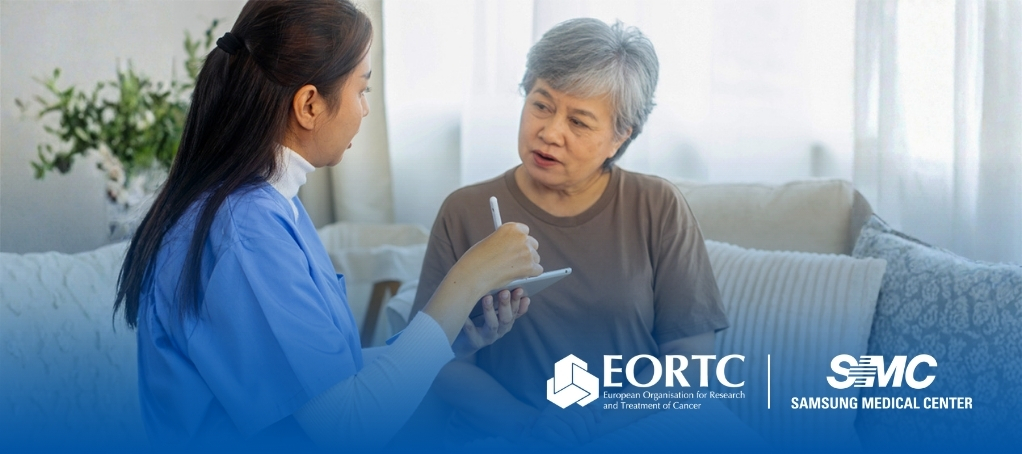
EORTC and Samsung Medical Center partner to strengthen Korean Quality of Life questionnaires’ validation
25 Mar 2026
Brussels, 25 March 2026: The European Organisation for Research and Treatment of Cancer (EORTC) is pleased to announce the signing of a Memorandum of Understanding (MoU) with Samsung Medical Center (SMC) in South Korea. This new collaboration formalises both organisations’ commitment to reinforce linguistic validity verification and quantitative validation of Korean versions of the internationally used EORTC Quality of Life questionnaires.
The EORTC Quality of Life Group develops rigorously tested, patient‑centred measures used worldwide to assess the impact of cancer and its treatments on patients’ daily lives. Ensuring high‑quality, culturally adapted translations is essential to preserving the scientific reliability of these tools, particularly as they are being used in global clinical trials and routine clinical practice.
Under this MoU, SMC will support the linguistic and psychometric validation of Korean EORTC questionnaire versions, contributing to this work with its expertise as a leading medical institution in Asia. The collaboration aims to strengthen:
- Linguistic accuracy and cultural relevance of Korean translations of EORTC Quality of Life questionnaires
- Quantitative validation studies to ensure measurement equivalence and robustness of the Korean language versions
- Scientific exchange to promote internationally harmonised approaches to patient‑reported outcome measures.
A shared commitment to high‑quality patient‑centred research
“This partnership represents an important step forward in ensuring that Korean patients’ voices are fully and accurately captured in clinical cancer research,” said Dagmara Kuliś, Associate Head of the EORTC Quality of Life Department. “The collaboration with Samsung Medical Center will help us continue to uphold the highest standards of quality and scientific integrity in our Quality of Life instruments.“
Juhee Cho, Director of Patient-Centered Outcomes & Value Enhancement Institute, from Samsung Medical Center added: “We are proud to partner with EORTC to strengthen the linguistic and cultural validity of patient‑reported outcome measures used across cancer research. This collaboration will support better understanding of patient experiences and contribute to improved cancer care in Korea.”
This MoU is part of EORTC’s expanding engagement with cancer research partners in Asia and globally, reinforcing its commitment to fostering international cooperation to improve the quality, inclusiveness, and impact of cancer and patient-reported outcome research worldwide.
About EORTC
The European Organisation for Research and Treatment of Cancer (EORTC) is a non-governmental, non-profit organisation, which unites clinical cancer research experts, throughout Europe, to define better treatments for cancer patients to prolong survival and improve quality of life. Spanning from translational to large, prospective, multi-centre, phase III clinical trials that evaluate new therapies and treatment strategies as well as patient quality of life, its activities are coordinated from EORTC Headquarters, a unique international clinical research infrastructure, based in Brussels, Belgium.
About the Quality of Life Group
The EORTC Quality of Life Group (QLG) strives to improve health-related quality of life (HRQoL) of cancer patients, through dedicated research and the use of HRQoL measures within cancer clinical trials and clinical practice. HRQoL constitutes an important aspect of cancer research and care: it gives a voice to patients, putting their experience at the forefront. The QLG is part of the European Organisation for Research and Treatment of Cancer (EORTC).
About SMC
Established in 1994, Samsung Medical Center (SMC) is a premier healthcare institution in Korea, dedicated to leading the future of medicine. Guided by the vision, “SMC, the Center of Future Medicine,” it focuses on achieving the highest therapeutic outcomes for patients with severe and complex diseases. Through world-class medical expertise and cutting-edge technology, SMC strives to provide a unique care experience that balances advanced clinical excellence with a deep commitment to patient happiness.
Beyond traditional Clinical Outcomes, we prioritize “Patient Outcomes”—the holistic recovery of both body and mind—to ensure the best quality of life for those under our care. As dedicated “Caregivers,” we foster a patient-centered, horizontal culture, ensuring a safe and sustainable environment that leads the new paradigm of global healthcare.
About SCCC (Samsung Comprehensive Cancer Center)
Since its launch as Korea’s first dedicated cancer facility in 2008 and its transition to a comprehensive hospital in 2013, SCCC has led the field in oncology. Guided by the vision, “The Hub of Hyper Precision Cancer Medicine,” we innovate care through advanced multidisciplinary teams and treatments—such as robotic and single-port surgeries—to minimize patient suffering and optimize clinical outcomes.
SCCC places the Quality of Life of patients and their families at the heart of our mission. Beyond clinical treatment, we provide a seamless cancer care continuum—integrating pain management, rehabilitation, and nutritional support to alleviate the burden of cancer. By bridging cutting-edge research with Hyper Precision Medicine, we ensure a total care experience that supports every stage of the patient journey, from prevention through to lifelong survivorship.
Contact
Caroline Hance (EORTC QLG Communications)
caroline.hance@eortc.org
Related News
Giving patients a voice in cancer care: EORTC Quality of Life Group outlines achievements and future priorities
30 Jul 2026
Susanne Singer elected Chair-Elect of the EORTC Quality of Life Group
25 Jun 2026
EORTC QLG Executive Committee – Chair-Elect election
12 May 2026
Researchers confirm the validity of the EORTC QLQ‑F17 questionnaire to assess cancer patients’ quality of life
19 Jun 2025
Election for the Chair of the EORTC QLG Early Career Investigator group
18 Feb 2025
EORTC QLG Executive Committee – Autumn/Winter 2024 elections
6 Nov 2024
Update on Health-Related Quality of Life in Solid Rare Cancers Project
26 Oct 2023
EORTC QLG Executive Committee – Autumn/Winter 2023 elections
19 Oct 2023
New study validates clustering of QLQ-30 HRQoL scales, which can help symptom burden management and inform clinical trial design
27 May 2022